Get a ranked visual match
The tool compares a clear uploaded face with its available celebrity pool and returns a top match plus additional candidates when available.
Upload one clear photo to see which celebrity your face most resembles with an AI-powered comparison.


Use one clear, front-facing photo with one person. Drag, click, or paste an image.
Examples show the kind of visual comparison this tool is designed to provide.
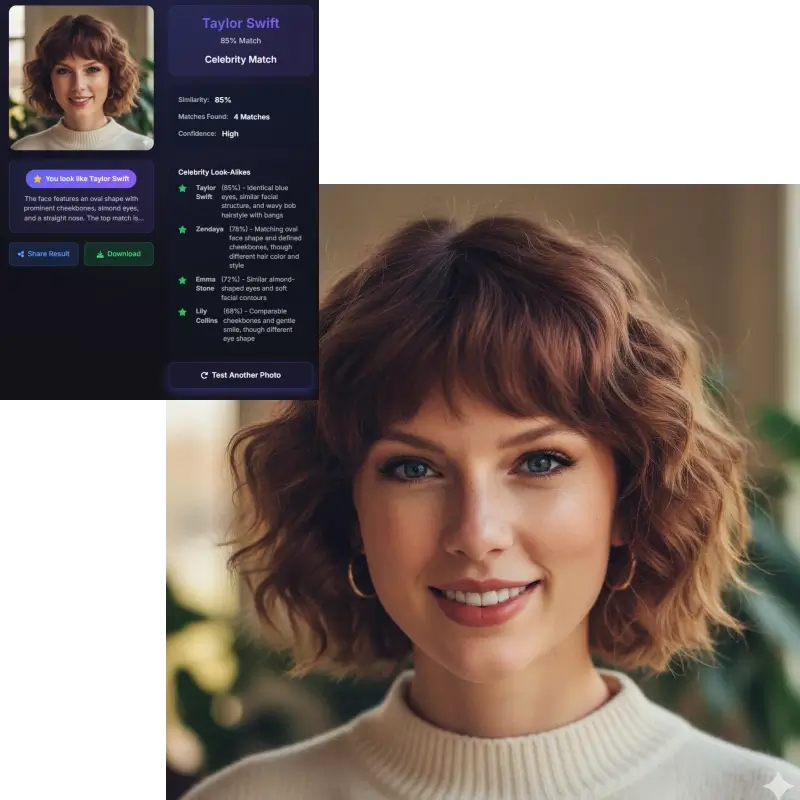

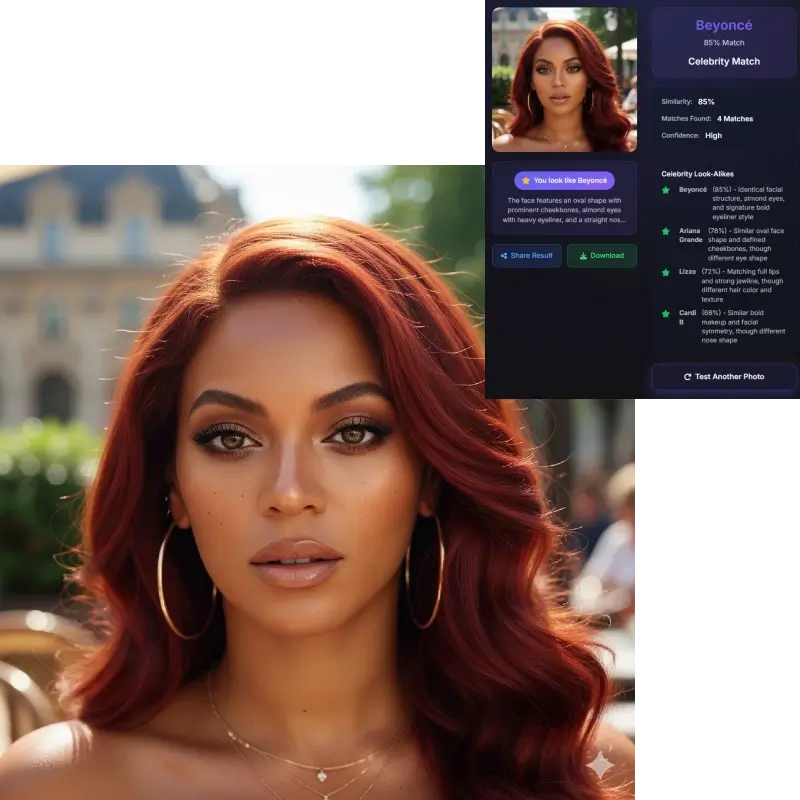
Use the upload tool first, then read the context below to understand what an AI match can and cannot tell you.
The tool compares a clear uploaded face with its available celebrity pool and returns a top match plus additional candidates when available.
Face shape, eyes, nose, mouth, jaw, expression, lighting, crop, and image quality can all change the visible comparison.
The output is an entertainment-oriented resemblance, not identity verification, a biometric conclusion, or a claim that you are related to a celebrity.
Start with one visible face, even light, a level camera, and minimal filters.
Select an image from your device and wait while the tool checks the visible facial cues.
Review the top result, similarity, confidence, and explanation; then retest only when you have a clear reason.
A photo matcher may compare face outline, eyes and brows, nose, mouth, cheeks, jaw, expression, and the way the face sits in the frame. These are visual cues, not proof of identity.
A smile, head turn, shadow, wide-angle selfie, hairstyle, or different celebrity pool can change the ranking. Repeated patterns across similarly framed photos are more useful than one dramatic score.
A photo matcher ranks visual similarity from an image. A quiz uses answers, while a chatbot explains language and context. Choose the format that matches the question you actually want answered.
Small changes in the image can change what the system can see.
Avoid strong backlight and hard shadows across one side of the face.
Keep the camera near eye level and show the forehead, eyes, nose, cheeks, jaw, and chin.
Start without sunglasses, stickers, heavy filters, or face reshaping.
The number is useful for ranking inside this tool, not for making serious claims.
Look for shared visible cues instead of treating a percentage as a universal probability.
Different tools have different celebrity pools, images, and ranking rules.
Read retention, deletion, training, and permission information before uploading more photos.
A fun comparison still uses a personal image. Share the minimum needed and read the site's policy first.
Check whether the image is deleted after analysis or kept for a stated period.
Upload your own photo or confirm you have permission to analyse someone else's image.
Do not include documents, private scenes, or extra personal information that the match does not need.
This tool provides a visual resemblance for entertainment. It is not identity verification, a medical assessment, or a definitive biometric result.
It is a photo-based comparison that estimates which public figures resemble the face in an uploaded image. The result is a visual suggestion, not identity verification.
It can be entertaining and sometimes convincing, but the result depends on the photo, lighting, angle, expression, celebrity pool, and ranking method. A score is not a universal probability.
A new crop, smile, head angle, lens, shadow, hairstyle, or database can change the visible geometry and ranking. Compare similarly framed photos if you want a fair retest.
Use one visible face, even front lighting, a level camera, moderate distance, and minimal filters. Avoid group shots, sunglasses, strong backlight, and extreme angles.
No. A dedicated matcher ranks an image against a celebrity pool. A chatbot can describe cues or discuss a result, but it is not the same as a specialised ranking tool.
Yes. Look for retention, deletion, model training, service-provider access, account requirements, and permission rules. Upload only what you are comfortable sharing.
Upload a clear photo for a quick visual comparison, then read the result with its limits in mind.