Famous twin intent
Built for searches such as celebrity doppelganger, famous twin finder, and how to find a celebrity doppelganger—not a quiz or identity check.
Upload one clear selfie to use this celebrity doppelganger finder. Compare visible facial cues, review the closest famous twin, and try another photo for consistency.


Use one front-facing photo with one person; avoid strong filters, sunglasses, and heavy shadows.
These examples show how a doppelganger-style result can highlight a closest public-figure resemblance without claiming an exact identity.

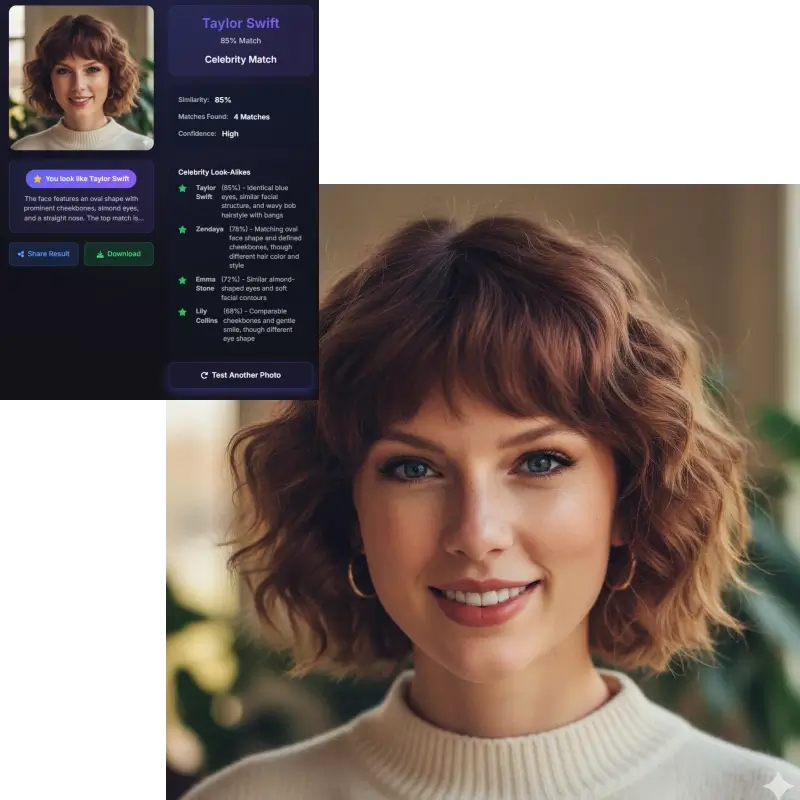
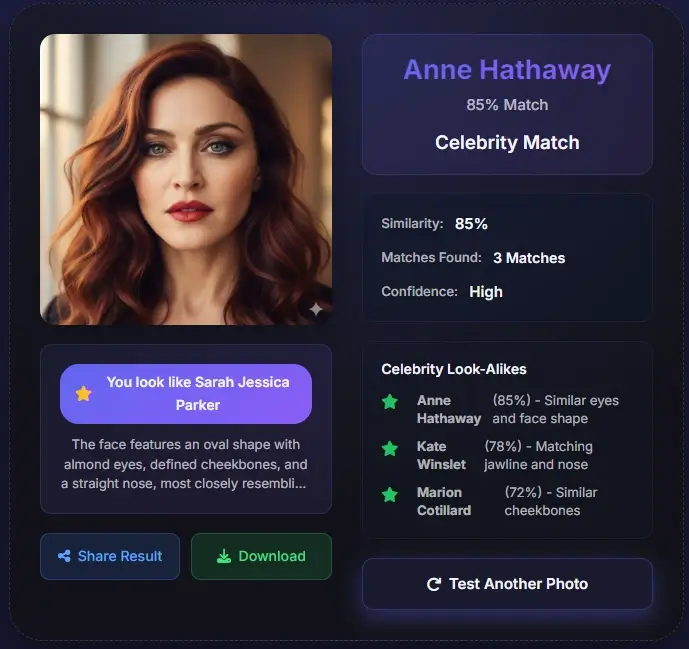
Celebrity doppelganger searches are about a close famous-twin resemblance, not identity. Upload a photo to compare visible facial structure and overall impression.
Built for searches such as celebrity doppelganger, famous twin finder, and how to find a celebrity doppelganger—not a quiz or identity check.
Use a real selfie so the tool can compare face shape, feature spacing, hair framing, expression, and lighting-dependent resemblance cues.
A doppelganger match is an estimated resemblance from one photo. Different angles, lighting, makeup, or facial expression can change the ranked match.
Choose one clear, front-facing photo with a single person. A visible face, even lighting, and no strong filter give the finder more consistent doppelganger cues.
The page checks visible facial landmarks, proportions, expression, and overall celebrity-face similarity signals.
Look at the ranked result, confidence label, and match wording. Treat the outcome as a fun resemblance guide, not a biometric identification claim.
Review the closest famous twin, confidence wording, and visible match cues. Try a second clear photo before treating a result as a stable resemblance.
A celebrity doppelganger result depends on the specific image you upload. A front-facing selfie lets the tool compare face shape, feature spacing, expression, hair framing, and other visual cues that a text quiz cannot read.
The tool treats doppelganger matches as resemblance estimates. It looks for public figures whose visible facial proportions and overall photo impression are closest to your image, then presents the result as a fun similarity guide.
If a match feels unexpected, use a second clear photo with different lighting. Consistent results across photos are more useful than a single image affected by shadows, filters, or a cropped face.
The tool can only compare what the image reveals, so cleaner inputs usually create more stable famous twin matches.
Single-person photos help the system focus on one set of facial landmarks. Group shots, reflections, or crowded backgrounds can weaken the comparison.
A straight or slight angle makes it easier to compare eye spacing, nose shape, jawline, and overall face proportions.
Balanced light reveals facial contours more clearly. Harsh shadows can change cheekbones, nose depth, and eye shape in the image.
Beauty filters, face reshaping, and strong edits can change the features being compared and make doppelganger results less natural.
A celebrity doppelganger result is strongest when a similar famous twin appears across more than one good photo. If every upload produces a different public figure, the first result may be photo-specific rather than a stable resemblance.
Different photos highlight different resemblance cues, so the same person may receive a new top match from another image.
A small head turn can alter apparent jaw width, eye placement, and nose shape, which affects similarity ranking.
Smiles, squints, raised eyebrows, and a tightened mouth all change the face the system sees in that moment.
Glasses, bangs, hats, beard shape, and makeup can make the photo feel closer to a different public figure.
If two or three good photos return similar famous twin matches, that result is more useful than one random upload.
A celebrity doppelganger finder should be fun and transparent about what it can and cannot prove.
Upload a photo you are comfortable testing. Avoid IDs, documents, children, medical images, or private scenes in the frame.
The result estimates visible resemblance to public figures. It should not be used to identify a person, verify identity, or make serious decisions.
A new photo can shift the match because lighting, angle, crop, expression, and hairstyle all affect facial similarity cues.
For broader matches, try the main celebrity look-alike finder. For performer-focused matches, use the actor or actress finder pages.
Upload a clear single-person photo, wait for the face comparison, and review the closest famous twin matches. For best consistency, test two photos with different lighting.
They overlap, but doppelganger usually means a stronger famous twin resemblance. A look-alike result can be broader and include weaker celebrity similarities.
The tool reads the uploaded photo, so angle, lighting, expression, hairstyle, glasses, and crop can change which celebrity appears closest.
Yes, if the face is clear and sharp. Very old, damaged, low-resolution, or side-profile photos may produce less stable matches.
No. It is a resemblance and entertainment tool. It does not verify who someone is or prove that two people are related.
A broad look-alike result can include several weaker similarities. A celebrity doppelganger result is narrower and is meant to highlight the closest famous twin when multiple visible facial cues line up in the uploaded photo.
One clear selfie can return a useful famous-twin estimate, but a second photo helps check whether the same doppelganger appears again or whether the first result depended on angle, expression, hairstyle, or lighting.
Upload a clear selfie and see which celebrity doppelganger your photo resembles most.