Best Celebrity Look Alike Apps and Sites: Which One Is Worth Trying?
A practical comparison of celebrity look alike tools, what each one does well, where they fall short, and how to pick the right option for quick fun, better explanations, or more privacy.

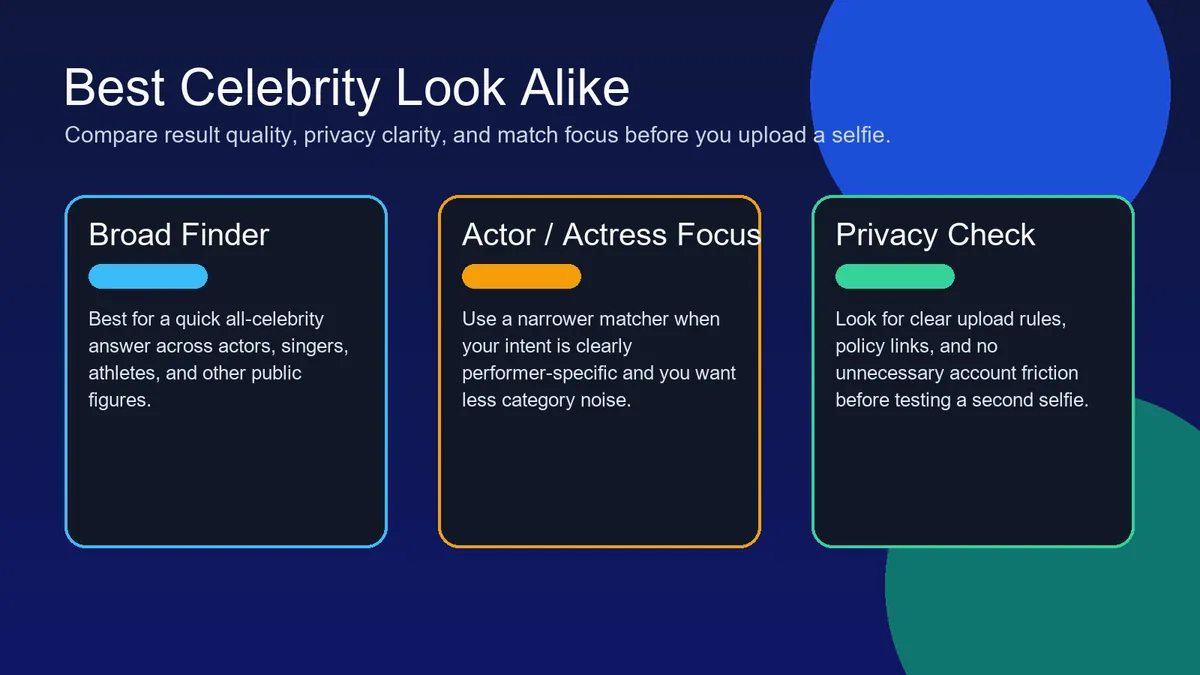
Table of Contents
Searches for the best celebrity look alike app usually come from one of three goals: you want a fun answer fast, you want a result that feels more believable, or you want more control over where your face photo goes. Most pages ranking for this topic only list names and screenshots. They rarely explain how result depth, category focus, privacy posture, or free-plan limits change the experience. This guide compares the tool types that matter and shows where My Celebrity Lookalike fits without pretending every tool serves the same search intent.
How We Judged the Best Celebrity Look Alike Tools
We used five comparison criteria: how clear the match result feels, whether the tool stays broad or lets you narrow the celebrity pool, how much useful guidance appears before and after upload, what the free experience actually gives you, and whether the page explains privacy or image handling in plain language.
This matters because two tools can both return a celebrity name, yet one may feel much more useful. A better tool usually tells you why the result happened, keeps the selfie flow simple, and avoids making you guess whether your photo will be stored, reused, or hidden behind account friction.
We also separated broad celebrity matching from narrower intents like actor-only or actress-only matching. A general celebrity finder should not automatically win if your search is really about a male actor match or a female performer match.
Best overall does not mean best for every user
The right pick changes with intent. Use a broad celebrity finder for entertainment, a category-specific page for actor or actress matches, and give extra weight to privacy clarity if you do not want your selfie sitting in an opaque pipeline.
Best Celebrity Look Alike Apps and Sites Compared
Instead of scoring random apps by hype, compare the main experiences users actually search for.
| Tool type | Best for | Strengths | Tradeoffs |
|---|---|---|---|
| General celebrity finder | People searching 'what celebrity do I look like' and wanting a fast all-around answer | Broad match pool, easy first test, usually the best entry point for casual users | May mix actors, singers, and influencers when the user really wants a narrower category |
| Actor-only matcher | Users who want male movie and TV performer matches | Cleaner search intent, fewer irrelevant celebrity categories, more targeted expectations | Less useful if the user wanted an all-celebrity answer |
| Actress-only matcher | Users who want female performer and actress-specific matches | Strong relevance for actress intent, clearer category fit, easier result framing | Will feel narrow if the user wanted musicians, athletes, or mixed celebrity results |
| Viral social app | Quick entertainment and shareable novelty | Fast onboarding, high entertainment value, often mobile-first | Can be weak on explanation, privacy clarity, and repeatable result trust |
Which Type of Celebrity Match Tool Fits Your Use Case?
Choosing the right page first usually improves the result more than endlessly retrying the same selfie.
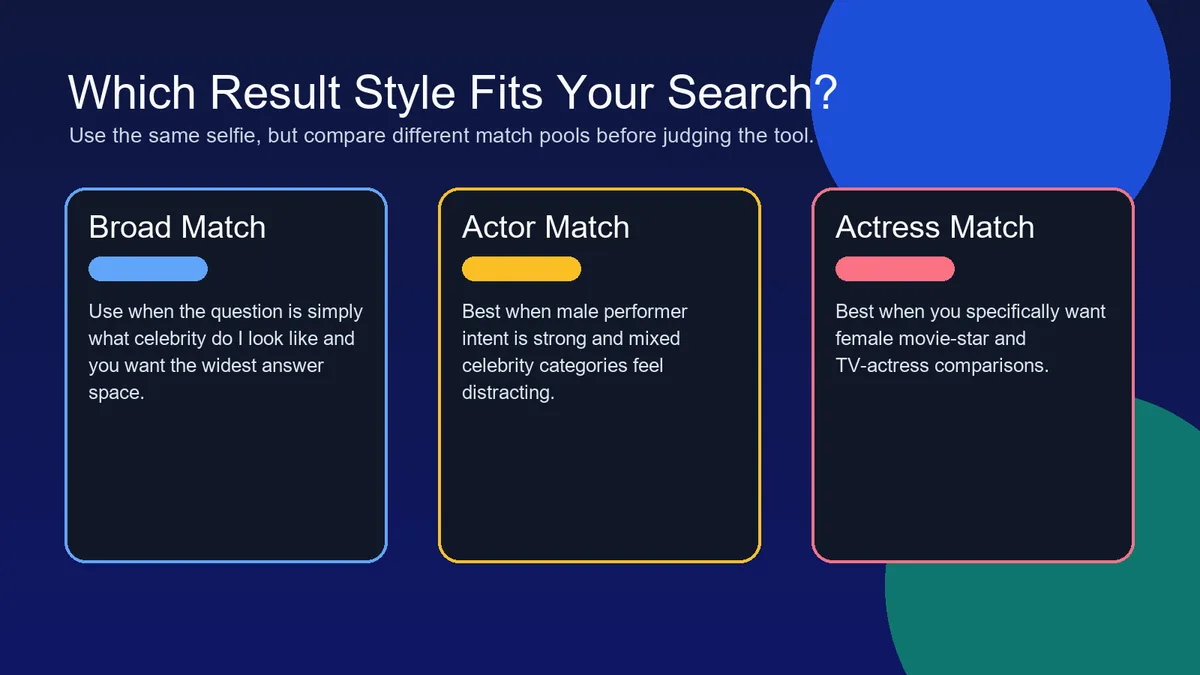
- Broad celebrity look alike finder - Best when you want a fast, general answer across actors, singers, athletes, and internet-famous public figures. This is the strongest choice for 'what celebrity do I look like' searches.
- Actor-only matcher - Better when you want male performer comparisons and do not want the result mixed with musicians, influencers, or actresses.
- Actress-only matcher - Useful when the intent is specifically female film and TV star matches. Narrowing the pool often makes the result feel more relevant.
- Social-face trend apps - These can be fun for quick viral moments, but many are light on explanation and can feel opaque about how the result was chosen.
- Face-analysis products with celebrity mode - These may provide more feature detail, but celebrity matching is often a side feature rather than the main user journey.
Photo Quality, Privacy, and Accuracy Checks Before You Upload
The easiest way to improve a celebrity match is still the photo itself. Use a centered single-person image, even front lighting, minimal filters, and a visible jawline and brow area. Group photos, heavy makeup filters, sunglasses, and severe shadows make the result less explainable.
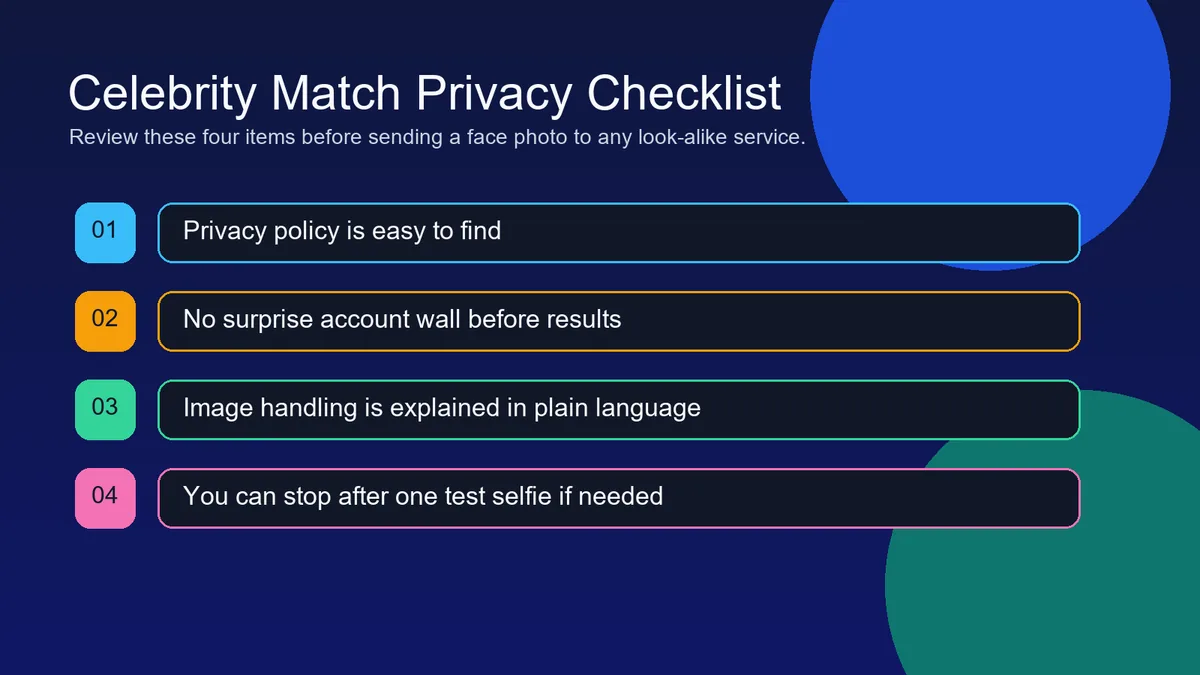
Privacy should be part of the buying decision even when the tool is free. Before uploading, check whether the page links to a privacy policy, whether sign-in is required, whether results can be used without handing over extra profile data, and whether the service explains what happens to uploaded images.
Accuracy claims also need context. These tools estimate visual similarity, not identity or biometric truth. A realistic service says the match can shift with angle, expression, age cues, hairstyle, or database scope instead of promising a magical final answer.
Simple privacy rule
If a celebrity match page makes selfie upload easy but data handling hard to understand, treat that as a quality warning and review the Privacy Policy.
How to Test Your Own Celebrity Match Well
Use this short workflow if you want to compare tools without wasting uploads.
- Start with the broad tool - Run one clean selfie through a general celebrity finder to see the widest match pool first.
- Retry with category-specific intent - If the broad result feels off, test the same selfie on an actor-only or actress-only page instead of changing five other variables at once.
- Compare explanation quality - Favor results that mention face shape, eye spacing, smile, jawline, or other cues over pages that only output a name.
- Check privacy before second upload - Once you know which service feels strongest, verify its data-handling page before uploading more photos or creating an account.
Best Celebrity Look Alike FAQ
Notes and Sources
- SERP review on June 5, 2026 found that many ranking pages for this topic are thin listicles with limited discussion of privacy, category intent, or result explanation.
- Keyword validation used Similarweb data on June 5, 2026. 'best celebrity look alike' showed difficulty 19 and window volume 140, while broader adjacent terms overlapped existing tool-page intent.
- Privacy evaluation criteria in this guide are based on whether a service clearly links policy and data-handling expectations on-page before or near the upload flow.
Last updated: June 5, 2026