Find a Closer Celebrity Resemblance
Upload one portrait to see which famous faces share visible patterns with you. The tool is for entertainment and resemblance discovery, not identity verification.
Upload one clear photo to compare your visible facial features with celebrity faces. Review a top match, several alternatives, and the cues that shaped the result.


Use one front-facing photo with one person. A clear, well-lit image makes the comparison easier to understand.
The example cards show how a face match can present a leading celebrity resemblance together with several visual alternatives.
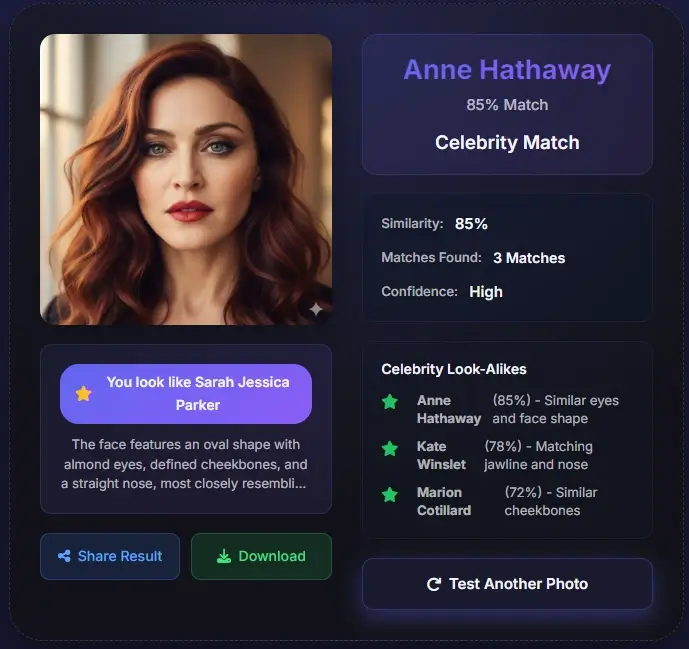

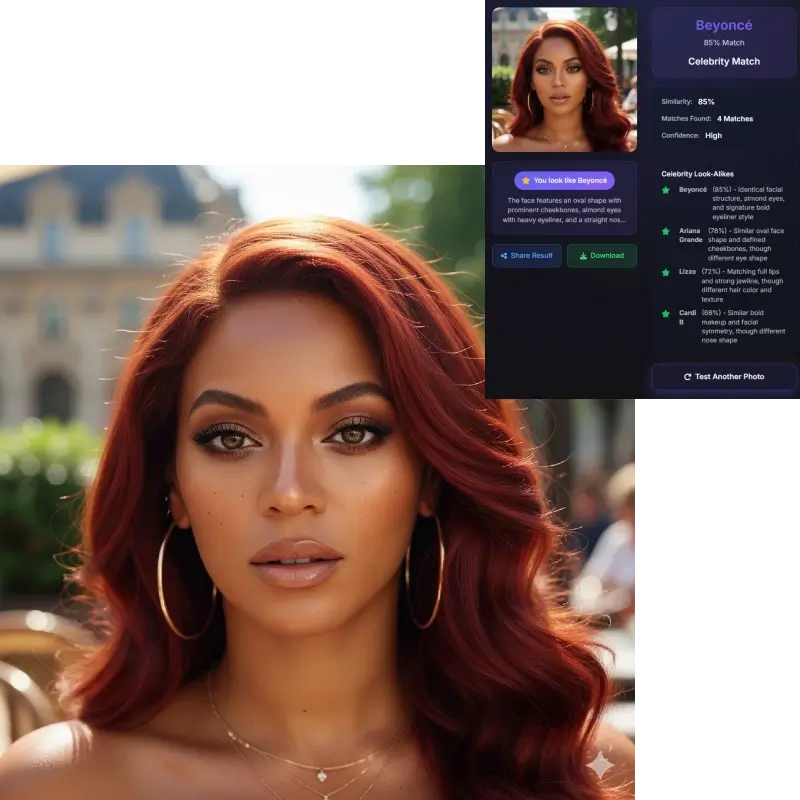
A celebrity face match turns a broad look-alike question into a clearer comparison: upload a photo, review the strongest visual matches, and understand what the image is showing.
Upload one portrait to see which famous faces share visible patterns with you. The tool is for entertainment and resemblance discovery, not identity verification.
A useful face match considers a group of cues such as overall face shape, eye spacing, brow line, nose structure, lip outline, cheekbone placement, jawline, and the balance of those features in the selected photo.
The result belongs to the image you upload. A different angle, expression, crop, lens, hairstyle, or shadow can change the visible geometry, so comparing two similar photos is often more informative than treating one result as a permanent label.
Start with one person, a mostly front-facing head-and-shoulders view, and even lighting. Avoid a group photo, strong filter, sunglasses, or a face covering when you want a readable comparison.
After upload, the face match flow checks the visible landmarks and broader proportions in the photo, then compares those patterns with celebrity face examples. The process evaluates the image rather than confirming who a person is.
Look at the leading celebrity face match, the similarity indicator, the number of alternatives, and the short reasons shown for each result. If the outcome feels surprising, try another neutral photo and compare the pattern.
People want a quick answer, but a name alone can feel random. A useful result pairs the leading match with a similarity signal, alternatives, and a short explanation of visible cues. This keeps the experience focused on resemblance rather than identity.
A celebrity matching face result can be influenced by the outline of the face, the width of the forehead and cheeks, eye position and spacing, the brow line, nose bridge and tip, lip shape, cheekbone prominence, chin projection, and jawline contour. Hair, makeup, glasses, facial hair, and camera perspective can also change what is visible. No single cue decides the result. The comparison is a combined visual estimate from the particular photo you provide.
A similarity percentage is best treated as a ranking aid inside the tool, not as a scientific measurement of personal identity. A 78% result does not mean that two people share 78% of their identity or that the match will repeat in every photograph. Compare the candidates for the same image and look for similar patterns in a second, fairly lit photo.
Face matching is sensitive to the information present in the image. A smile changes the cheeks and mouth; a three-quarter angle changes the apparent nose and jaw; hard light creates new shadows; and a wide phone lens can stretch features near the edge. Hairstyle and glasses can also change the outline. Compare photos with similar framing and lighting instead of mixing a studio portrait with a heavily edited selfie.

Use this face match for feature-led comparison across many famous people. Choose the general look alike finder for broad uploads, the doppelganger finder for a famous twin, or actor pages for a category-specific search.
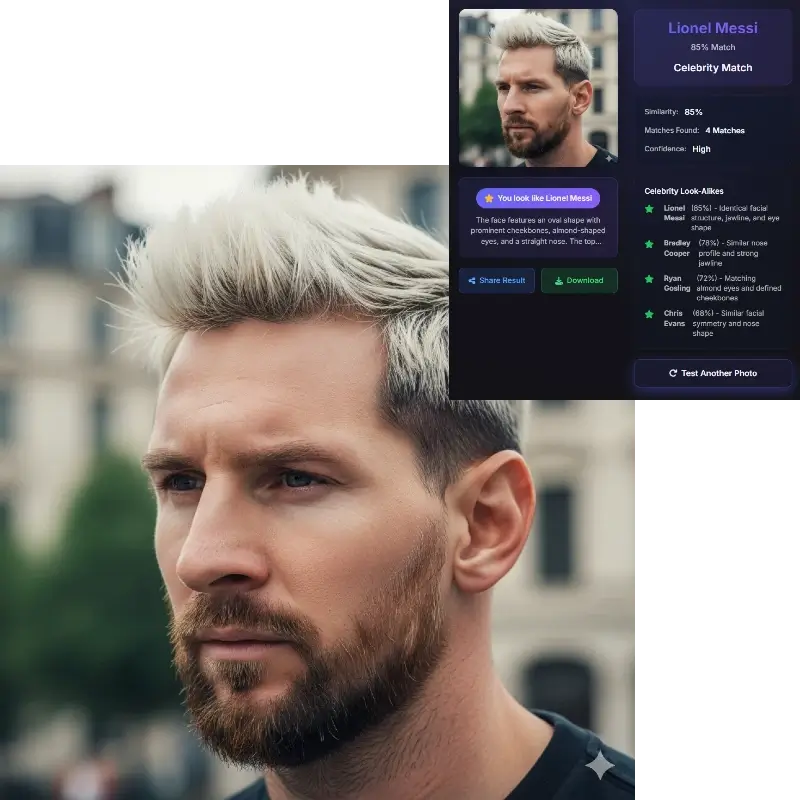
The tool can only compare the features that the photo reveals. A neutral baseline gives the result a clearer meaning.
A single-person photo keeps the comparison focused. Group shots, reflections, and busy backgrounds can make it harder to identify the intended face.
Centering the head and leaving a little space around it reduces edge distortion and makes the visible outline easier to compare.
Balanced light shows the eyes, nose, cheeks, and jaw without adding strong shadows that can make the same face look dramatically different.
Face reshaping, smoothing, high contrast, and heavy color effects can change the features used for a celebrity face match.
A face match is a visual estimate for entertainment. Use the result as a prompt for curiosity, not as proof about a person.
Look for a repeated resemblance across similar photos and several cues. A single high score can be driven by angle, hairstyle, or expression.
There may be several reasonable matches because facial resemblance is subjective and a photo can share different cues with different public figures.
The celebrity label describes a resemblance pattern in the image. It does not identify the person in the photo or establish a personal connection.
Upload only images you are allowed to use, avoid sensitive photos, and review the privacy policy before submitting an image for analysis.
Face-based tools work with personal images, so you should understand the handling expectations and the limits of a visual comparison before uploading.
Before using any face match service, check whether uploads are retained, how long temporary processing lasts, whether images are used for training, and whether a third party receives the file.
A celebrity face match is a resemblance estimate from one image. It should not be used to identify a person, make sensitive decisions, or imply a verified relationship.
Lighting, angle, expression, crop, resolution, accessories, and styling all influence what the system can see. Results can legitimately change when those conditions change.
Use a photo you have permission to submit, avoid other people when possible, and review the site's Privacy Policy before uploading a sensitive or private image.
A celebrity face match is a photo-based comparison that looks for visible resemblance between the uploaded face and celebrity face examples. It may consider face shape, eye area, nose, lips, cheeks, jawline, and overall balance in that specific image. It is an entertainment result, not identity verification.
You upload a clear portrait, the system reads visible facial landmarks and broad proportions, and it ranks celebrity examples with similar patterns. The result is based on the image you submitted, so a different angle or expression can produce a different ranking.
Use one person, a mostly front-facing view, even lighting, a neutral expression, and enough resolution to see the eyes, nose, mouth, cheeks, and jaw. Avoid sunglasses, heavy filters, blur, extreme side angles, and faces partly covered by hair or clothing.
The top match can change because a new photo reveals different geometry. Smiling changes the cheeks and mouth, a head turn changes the apparent jaw and nose, and harsh lighting adds shadows. For a fair comparison, test similar photos rather than mixing very different conditions.
They are related but not identical search intents. A face match emphasizes visible feature comparison across celebrity examples, while a celebrity twin or doppelganger finder emphasizes the idea of a famous double. Use the wording that best describes what you want to explore.
No. A resemblance result should not be used to identify a person or make a sensitive decision. It describes a visual similarity estimate from one photo and can be affected by lighting, angle, styling, and image quality.
No. The result is a ranked visual comparison, not proof of an exact twin relationship. Similarity is subjective and photo dependent. Look for repeated cues across similar photos instead of treating one score as a permanent label.
Use the share or download controls when available, but check for private details first and share only a photo and result you are comfortable showing. Do not share someone else's image without permission.
The page is designed as a free upload-first experience, but availability and limits can depend on the live service. Read the page notices and privacy information before submitting a photo.
Try a second photo with softer light, a straighter angle, less editing, and a centered face. If the result still feels inconsistent, treat it as a playful estimate and use the general finder or a category-specific actor or actress page for a different comparison.
Upload a clear photo, review the closest celebrity resemblance, and use the comparison guidance to understand what the image is really showing.