K-pop Look Alike: How to Find Your Idol Match from a Photo
A practical guide to K-pop idol look alike searches, photo prep, result interpretation, privacy checks, and when to use a broad celebrity matcher instead of a fandom quiz.

Table of Contents
Searches for K-pop look alike usually come from a fun question: which idol shares your face shape, eyes, smile, or overall camera presence? The challenge is that many results online mix real face similarity with styling, fan edits, filters, or quiz-style personality prompts. This guide keeps the search practical. It explains how to prepare a usable photo, what features to compare, how to interpret a result, and when a general celebrity look alike finder is a better starting point than a narrow quiz.
What Does a K-pop Look Alike Result Really Mean?
A K-pop look alike result is a resemblance estimate based on visible cues in one photo. It is not identity verification, ethnicity classification, or a statement that you share a background with an idol. The best way to read the result is as a photo-specific match: in this image, your face geometry, expression, hairstyle, or styling overlaps with the public photos available for that celebrity category.
K-pop styling can make resemblance feel stronger than it really is. Hair color, bangs, soft contouring, lens choice, stage makeup, and camera angle can all pull a selfie toward an idol-like look. That is why a result may change when you switch from a filtered selfie to a plain daylight portrait.
The most useful K-pop look alike checks separate structure from styling. Face shape, eye spacing, brows, nose bridge, lip shape, and jawline are structural cues. Hair, makeup, accessories, and pose are styling cues. Both can matter, but they should not be confused.
Read it as resemblance, not identity
A good result should help you notice which visual cues are similar. It should not imply that you are the same person, related to the idol, or guaranteed to match across every photo.
Best Photo Setup for a K-pop Idol Look Alike Test
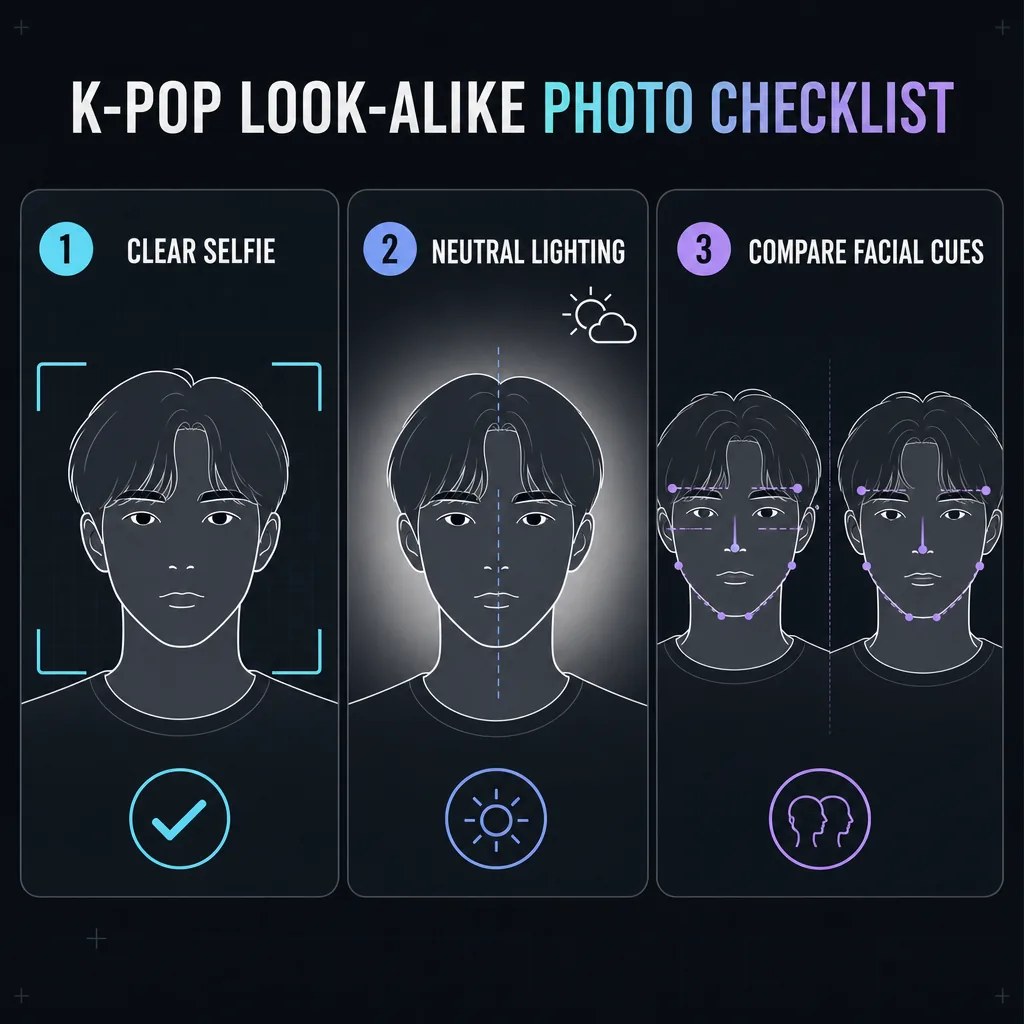
A better input photo usually improves the match more than trying five random tools. Use a selfie that shows your actual facial structure before you test styling variations.
- Start with one clean portrait - Use a single-person selfie with your full face visible. Avoid group photos, sunglasses, heavy blur, masks, and extreme beauty filters.
- Use soft front lighting - Even lighting keeps shadows from changing the apparent nose, cheekbone, eyelid, and jawline shape.
- Keep the first test neutral - A natural expression makes it easier to compare structure. After that, try a smiling photo to see whether the mouth and cheek cues shift the match.
- Separate hairstyle from face match - K-pop styling is powerful. If a result appears only after a specific hair color, bangs, or makeup style, treat it as styling resemblance rather than pure facial similarity.
- Use the same photo across tools - When comparing services, changing the photo and the tool at the same time makes the result hard to judge.
How to Read the Face-Match Signals
Do not stop at the first idol name. A useful K-pop look alike result should give you a reason to believe the match: similar face outline, comparable upper-face balance, a shared smile shape, or a styling overlap that explains the first-glance impression.
If the tool gives no explanation, do your own quick audit. Compare the result in three parts: structure, expression, and styling. When all three point in the same direction, the match is more believable. When only styling matches, the result may still be fun, but it is weaker as a face comparison.
| Signal | What it means | How to check it |
|---|---|---|
| Face shape | The overall outline may match an idol's oval, heart, round, or sharper profile. | Compare a front-facing selfie with a front-facing reference, not a stage angle. |
| Eyes and brows | Upper-face balance often drives first-glance resemblance. | Look at eye spacing, eyelid shape, brow angle, and expression separately. |
| Smile and cheeks | Some matches appear only when you smile because the cheek and mouth shape changes. | Test one neutral photo and one smiling photo to see whether the result stays stable. |
| Styling overlap | Hair, makeup, lenses, and pose can create an idol-like impression. | Ask whether the resemblance remains when styling is removed or simplified. |
Tool Options, Quizzes, and Limits
Different K-pop look alike pages serve different search intents. Pick the format that matches what you actually want.
- Broad celebrity look alike finder - Best when you want a real photo-based comparison and are comfortable seeing K-pop idols mixed with actors, singers, and other public figures.
- K-pop-only quiz - Good for fandom entertainment, but many quizzes use preference or personality prompts rather than actual facial analysis.
- Social filters - Useful for playful idol-style transformations, but filters often change your face enough that the match becomes a styling effect.
- Manual comparison - Helpful when you want to compare specific idols. Look at front-facing photos with similar lighting instead of mixing stage shots and casual selfies.
- Old photos or childhood photos - These can be fun, but face proportions, camera quality, and age cues make matches less stable than a recent clear selfie.
Privacy and Respectful Comparison
A K-pop look alike search still involves a face photo, so privacy matters. Before uploading, check whether the page links to a privacy policy, whether sign-in is required, whether the tool explains image handling, and whether it asks for data that is not needed for a match.
Respectful wording also matters. Compare visual cues, not identity, background, ethnicity, body, or personal worth. A healthy result says which facial or styling features overlap with an idol photo; it does not rank you, diagnose you, or turn public figures into stereotypes.
If a result feels off, try one more clean photo before assuming the tool is wrong. Changes in angle, expression, hair, and lighting can move a match from one idol style to another.
Simple upload rule
If you would not be comfortable using a selfie online, do not upload it to a look alike tool. Review our Privacy Policy.
How to Try a K-pop-Style Celebrity Match
My Celebrity Lookalike is a broad celebrity matcher, not a K-pop-only database. Use it when you want a photo-based celebrity comparison, then interpret any idol-style result with the checks above.
- Upload the cleanest selfie first - Start with a recent, front-facing portrait so the first result is based on your face rather than a filter.
- Read the match explanation - Look for cues such as face shape, eyes, smile, jawline, or overall balance.
- Try one styling variation - If you want an idol-style comparison, test one hair or makeup variation after the neutral photo, not before.
- Compare with actor or actress pages if needed - If the broad result feels too mixed, use the actor or actress pages for a narrower celebrity pool.
K-pop Look Alike FAQ
Notes and Sources
- SERP review on June 11, 2026 found K-pop look alike results split between fandom quizzes, social filters, and general celebrity matching tools.
- Similarweb keyword validation on June 11, 2026 showed 'kpop look alike' as a distinct low-difficulty opportunity, while broader upload-photo and best-tool terms overlapped existing pages.
- This guide avoids naming real idols as guaranteed matches because a look alike result depends on photo context, styling, and the available celebrity pool.
Last updated: June 11, 2026